
What the key opens.
The tag is a short opaque token and nothing else. Everything below is what that token connects to — and how it stays attached to the animal rather than to whoever happens to hold them.
The tag is the key. The record is what it opens.
Nothing about your animal lives on the tag itself — it carries a short opaque token and nothing else. What the token opens is a record that belongs to the animal, and that the people around them connect into.
- urSmartIDThe physical key. A tap, a scan, or a short code.
- IdentityurLifePrint — who the animal is, kept separate from who holds them.
- Veterinary careVisits, medications, allergies and vaccinations, each attributed to whoever recorded it.
- Lost & FoundA finder-safe path home, with LABRIE™ recovery intelligence behind it.
- CaregiversSitters, walkers, a vet of record, a foster — each seeing only their part.
- CaregiversWho cares for the animal now, and who did before.
- Shelters & rescuesIntake and history that travel with the animal to its next home.
- BreedersEarly-life information, attributed to its source.
- LicensingMunicipal licensing, readable by animal control in a single scan.
- Life historyAn append-only record of what happened and when.
- Environmental contextLABRIE™ — species behaviour, geography and weather, applied to recovery.
The animal is the constant
People change, vets change, homes change. The record is anchored to the animal, not to whoever happens to hold them this year.
Not a record inside someone else's system
A clinic's file lives in the clinic. A shelter's file lives in the shelter. Here the animal is the thing everything connects to, so the history survives the relationship ending.
A key can be replaced
Lose the tag and you replace the key, not the record. New tag numbers, same animal, same history, same identity.
The tag is how someone reaches you.
The urLifePrint is who your animal is.
A tag can be lost, replaced, reassigned, or cut off a collar. An animal's identity cannot. So we keep them apart on purpose — the tag is an access mechanism, and the urLifePrint is the record it opens.
Every animal gets one
A photographic identity record, captured through a guided sequence on your phone, kept for the animal's whole life and added to as they change. Dogs, cats, horses, livestock, the lot.
A urLifePrint ID, separate from the tag
Its own identifier, issued when capture is complete. Replacing a lost tag issues new tag numbers and never touches the animal's identity — same record, same history, same ID.
Three separate questions, kept separate
Who the animal is, who holds them, and who you are, are three different facts. We never collapse them into one “verified” badge, because that badge would be hiding which of the three it meant.


The emergency side does the work
Medications, allergies and reactions, recent vaccinations, the microchip number, and the national poison-control lines — on a card in your wallet, readable by a vet who has never met your animal.
A scan tells you it happened
When someone opens the emergency code on the back of the card, every owner on the record is told which card was opened, and when. Checking the card with the front code notifies no one.
It keeps up with them
Animals change — a puppy is not the dog it becomes. Re-capture across their life is part of the record, not a re-registration.
And when it is asked to recognise a photo, it will tell you it isn't sure.
A photo match that returns its closest guess is worse than useless — it is a confident wrong answer about somebody's animal. Ours returns no match instead, and says so plainly. We would rather hand you nothing than hand you a name we cannot stand behind.
Every animal enrolls today. Photo recognition answers for dogs now and is being trained species by species — your animal's urLifePrint is captured and kept from the day you create it, and starts answering the moment its species is trained.
Activating the tag is where the record starts
When you link a tag to your animal, you are already standing next to them with a phone in your hand. So that is where we ask — the first thing offered when activation finishes is the guided capture, a handful of framed shots that become the urLifePrint. It takes a few minutes once, at the only moment it is genuinely easy, instead of becoming the thing you meant to do and never did.
Two channels. One resolver. Zero friction.
Every tag ships with both NFC and QR. Use whatever the finder's phone supports — the result is the same.

Tap (NFC)
Any modern phone (iPhone 7+, most Android) reads the chip with no app. One tap opens the resolver page.
Scan (QR)
The QR code printed on the back works with any camera app — no install, no login, even on older phones.
Resolve
The resolver checks who's scanning — finder, vet, animal control — and shows exactly the right information for that role.
The tag is the key. These are the rooms it opens.
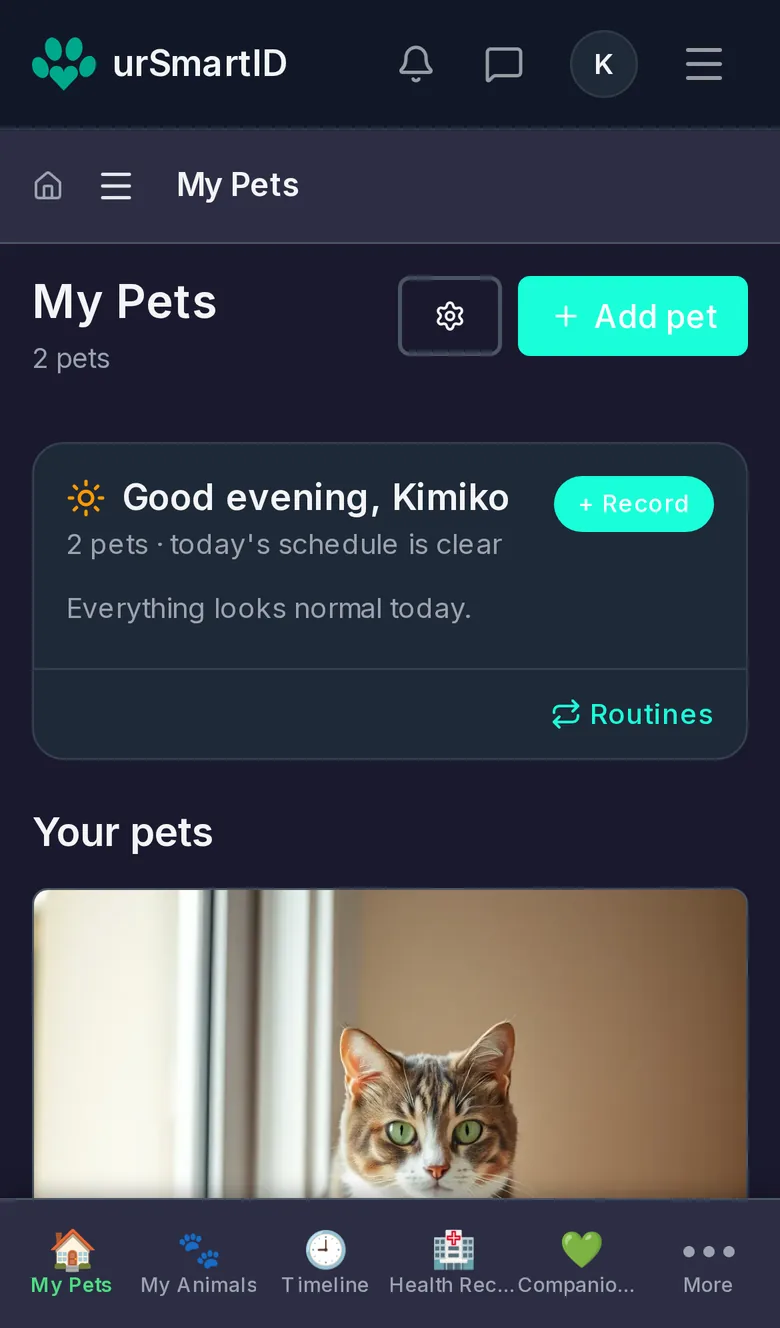
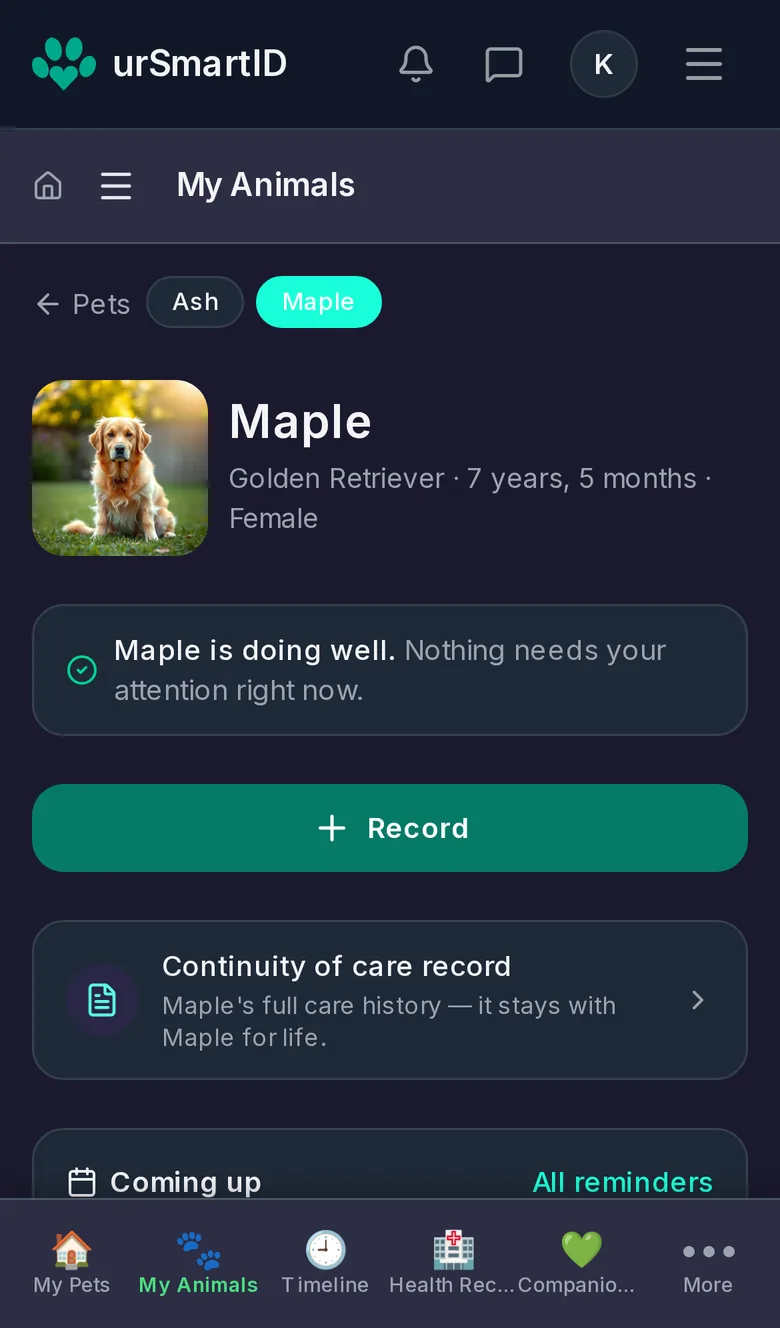
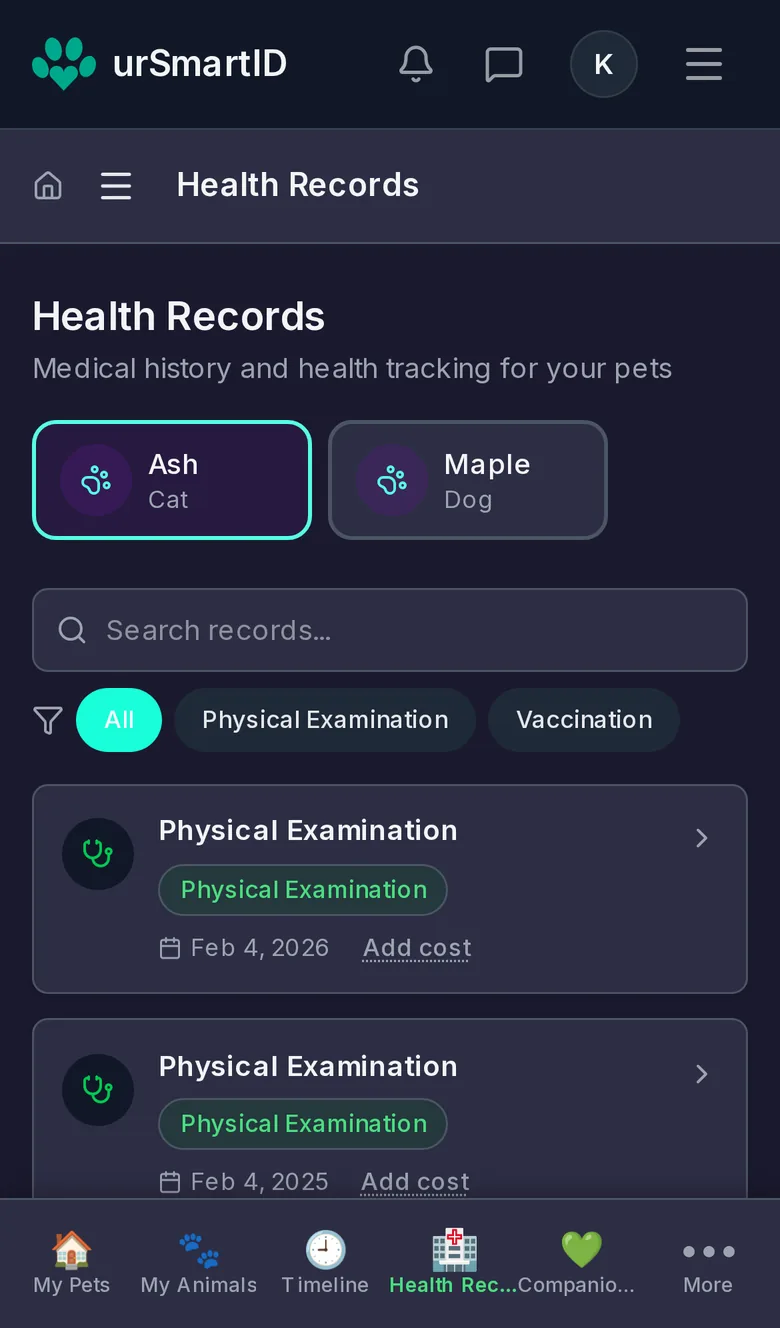
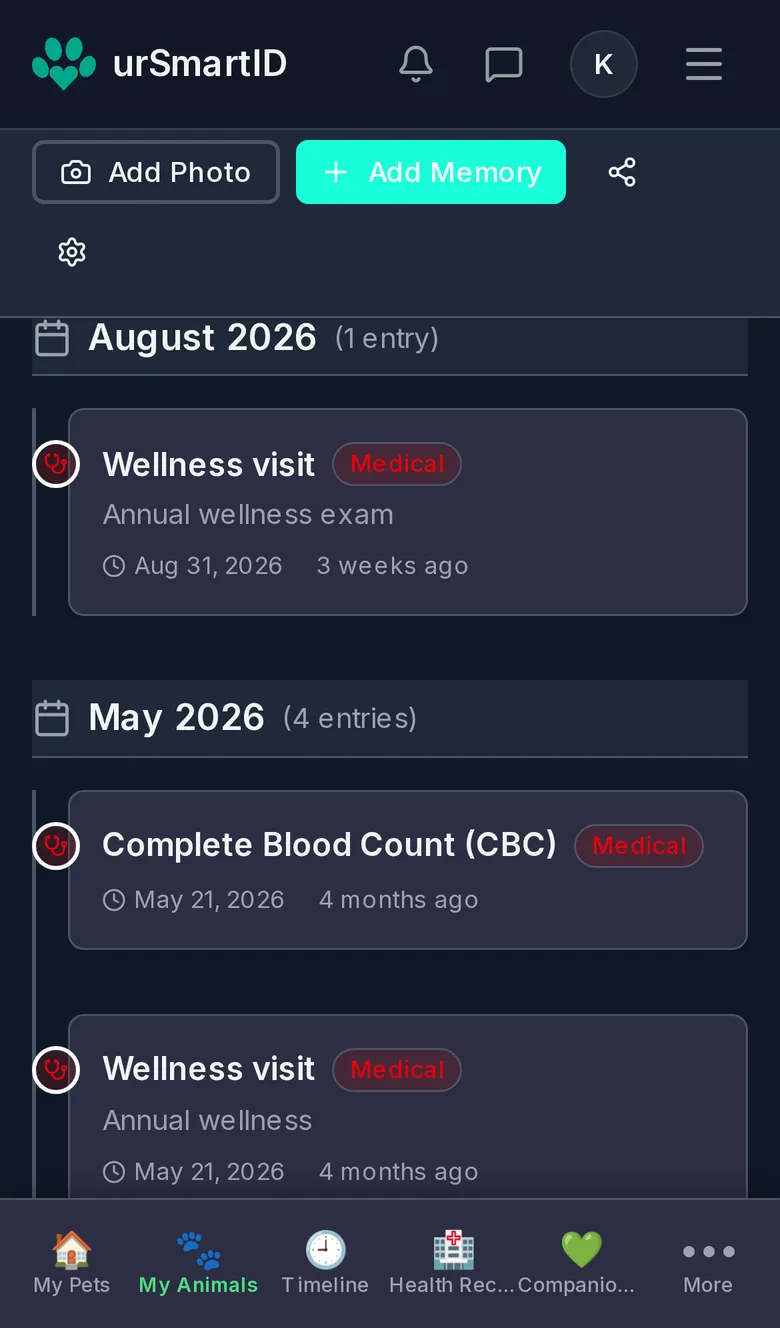
Activating a tag gives you your pet's own record and the tools around it, on any phone, with no app to install and no subscription. The screens are real, shown with a demonstration pet.
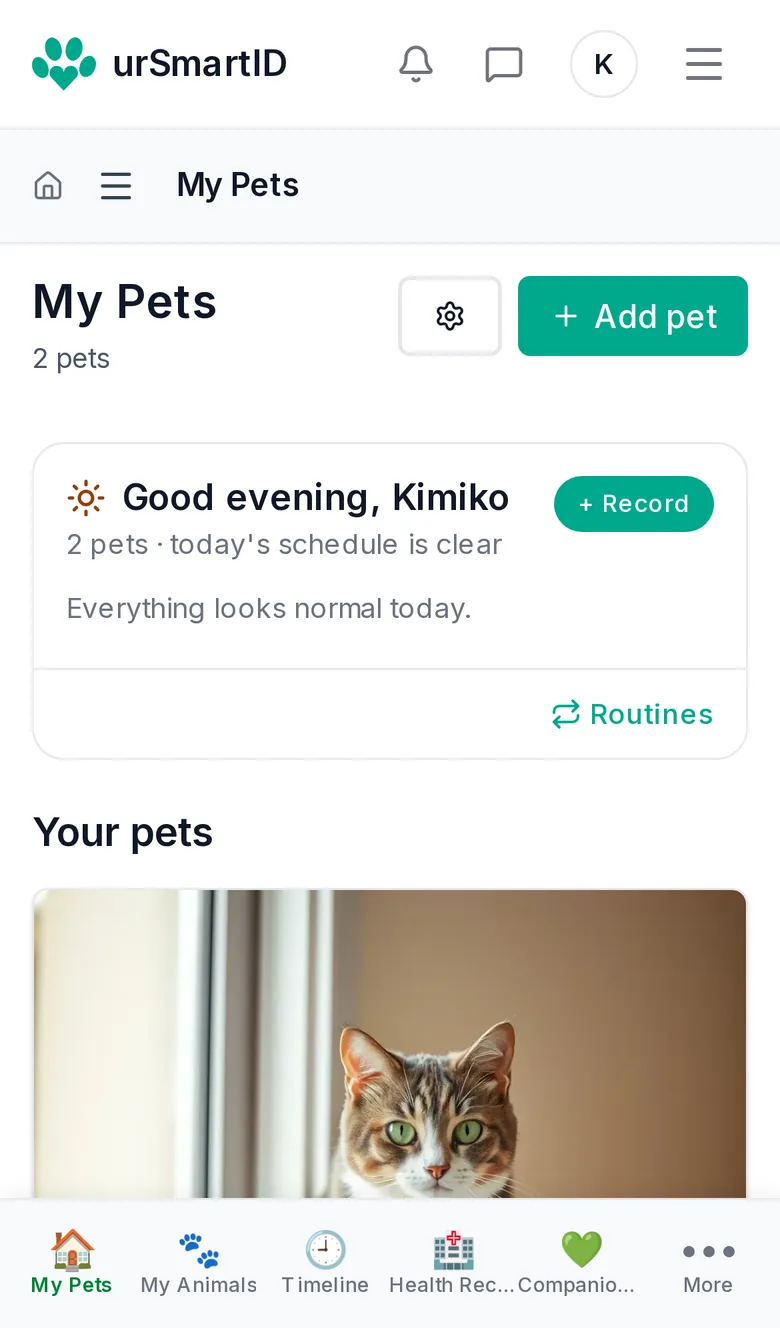
Every pet at a glance
One home for all your animals: what needs attention today, and what is coming up.
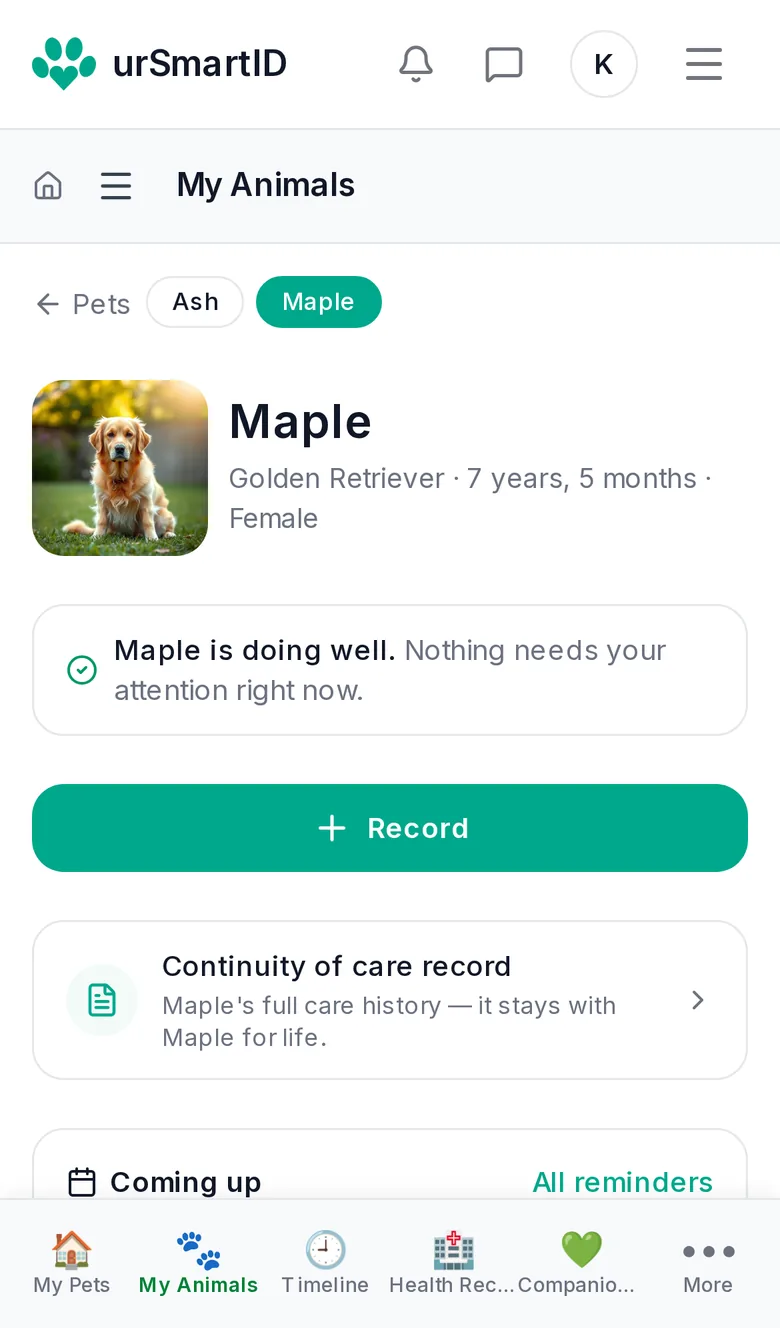
A record for each pet
Their profile and their continuity-of-care record, which stays with them for life.
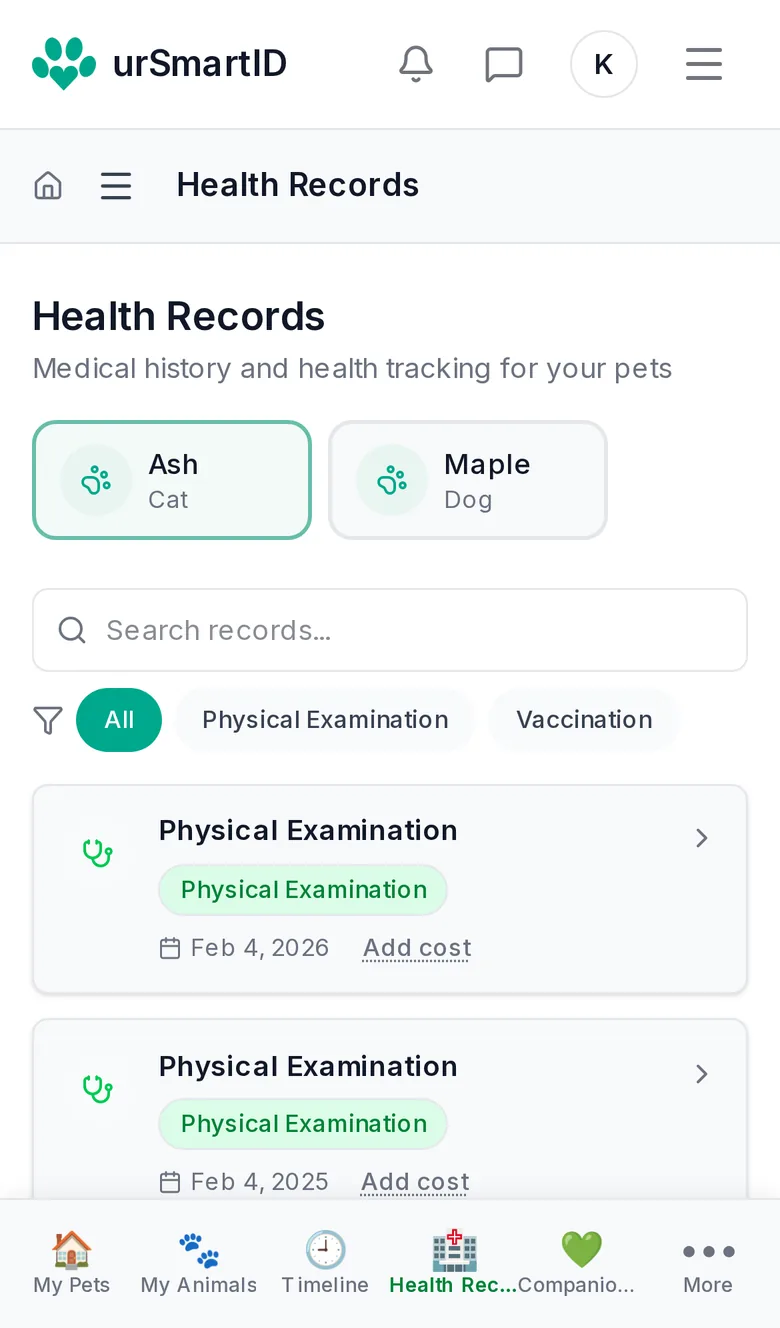
Medical history in one place
Exams, vaccinations and results, whichever clinic recorded them.
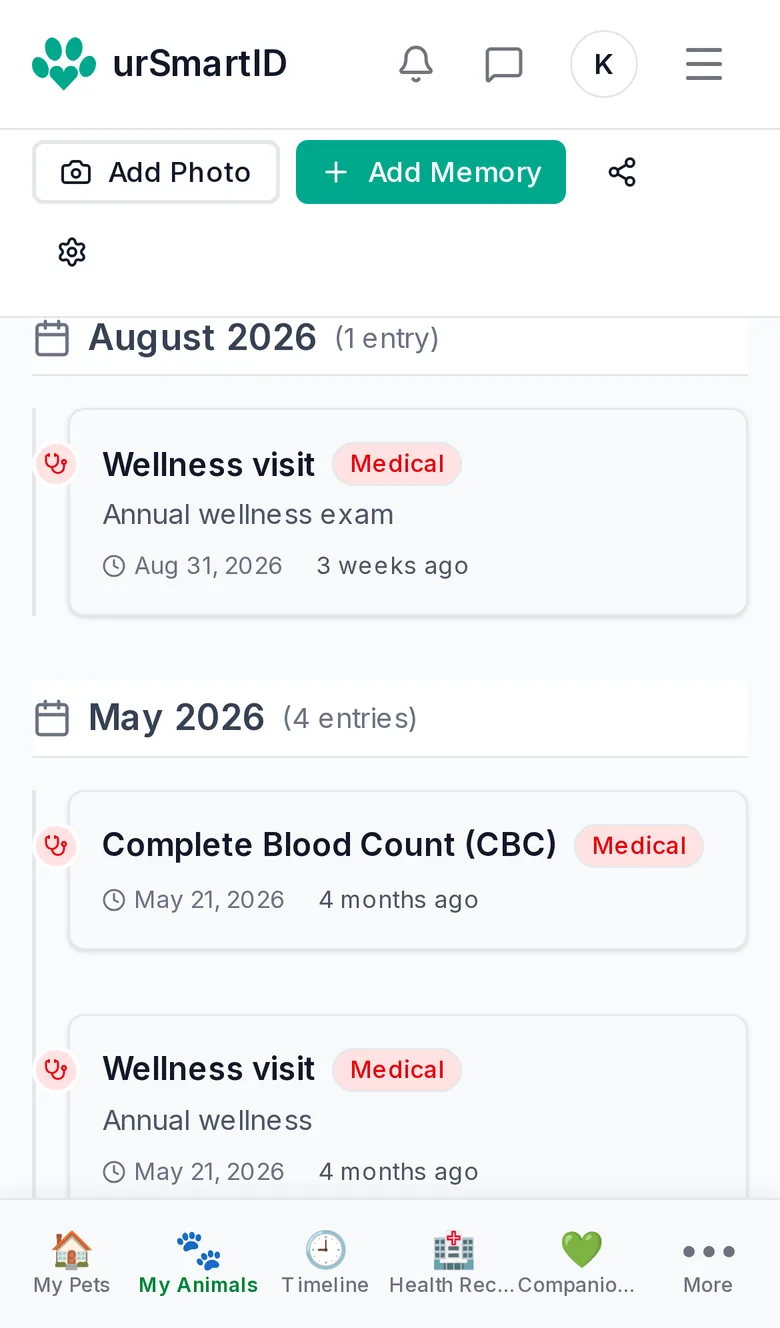
Their whole life, in order
Every visit, test and milestone on one timeline.
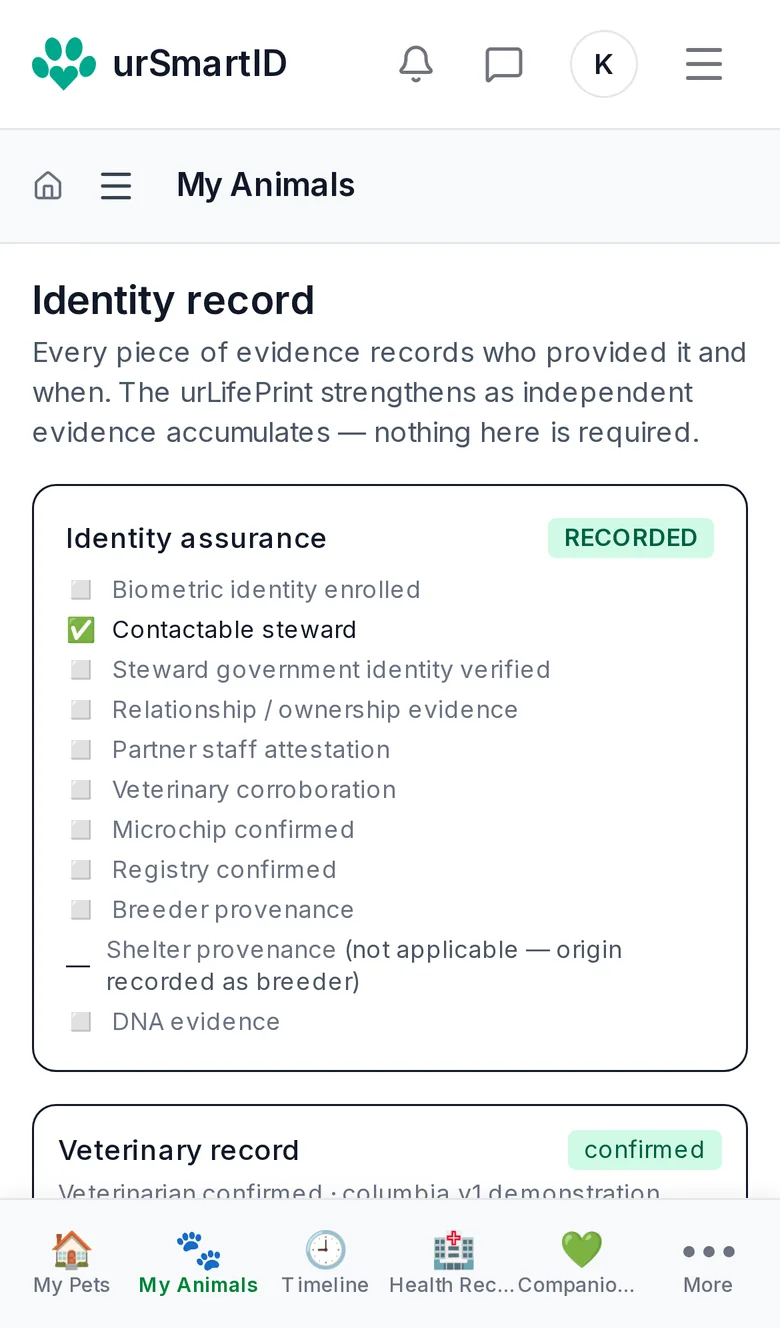
Evidence of who they are
An identity assurance level, and what backs it: steward, veterinary record, provenance. It builds over time.
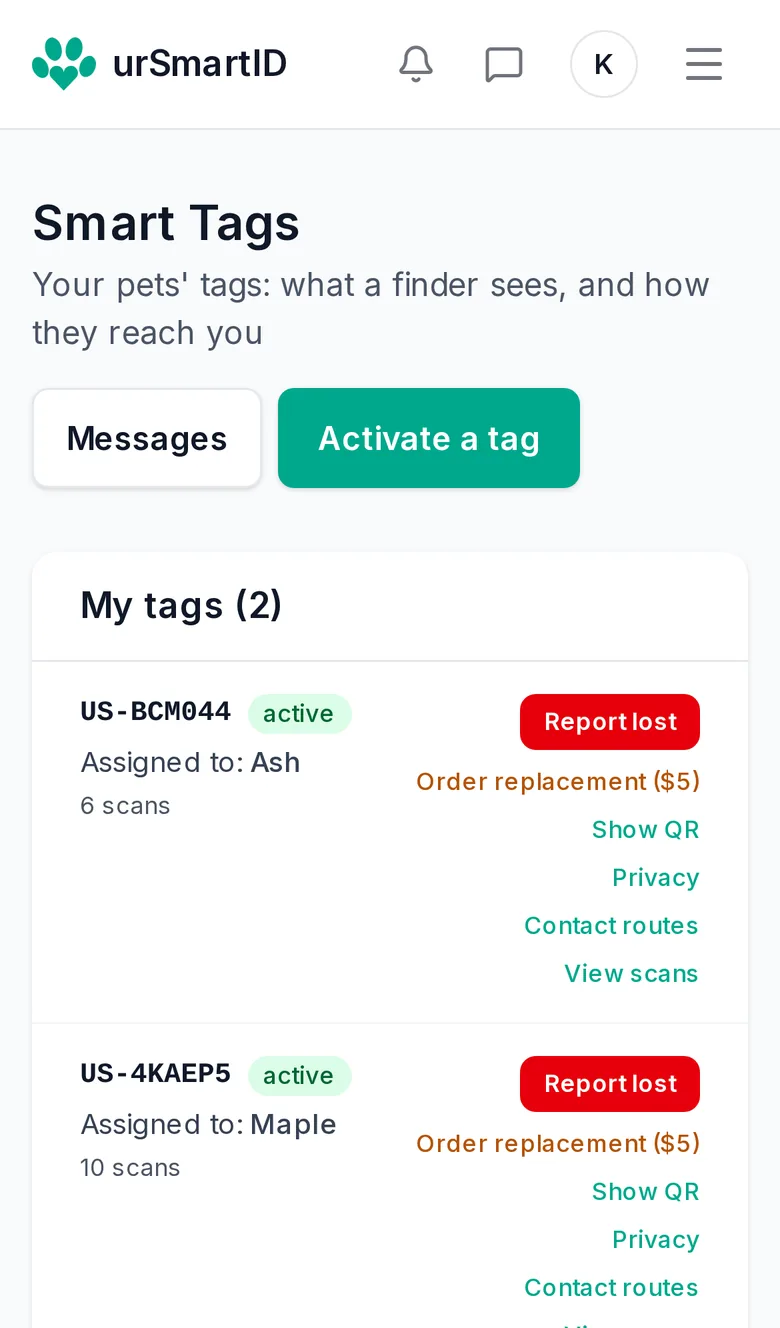
Your tags, in your hands
Switch lost mode on or off, choose your emergency contacts, show or download the QR, and order a $5 replacement (+$4.99 shipping).
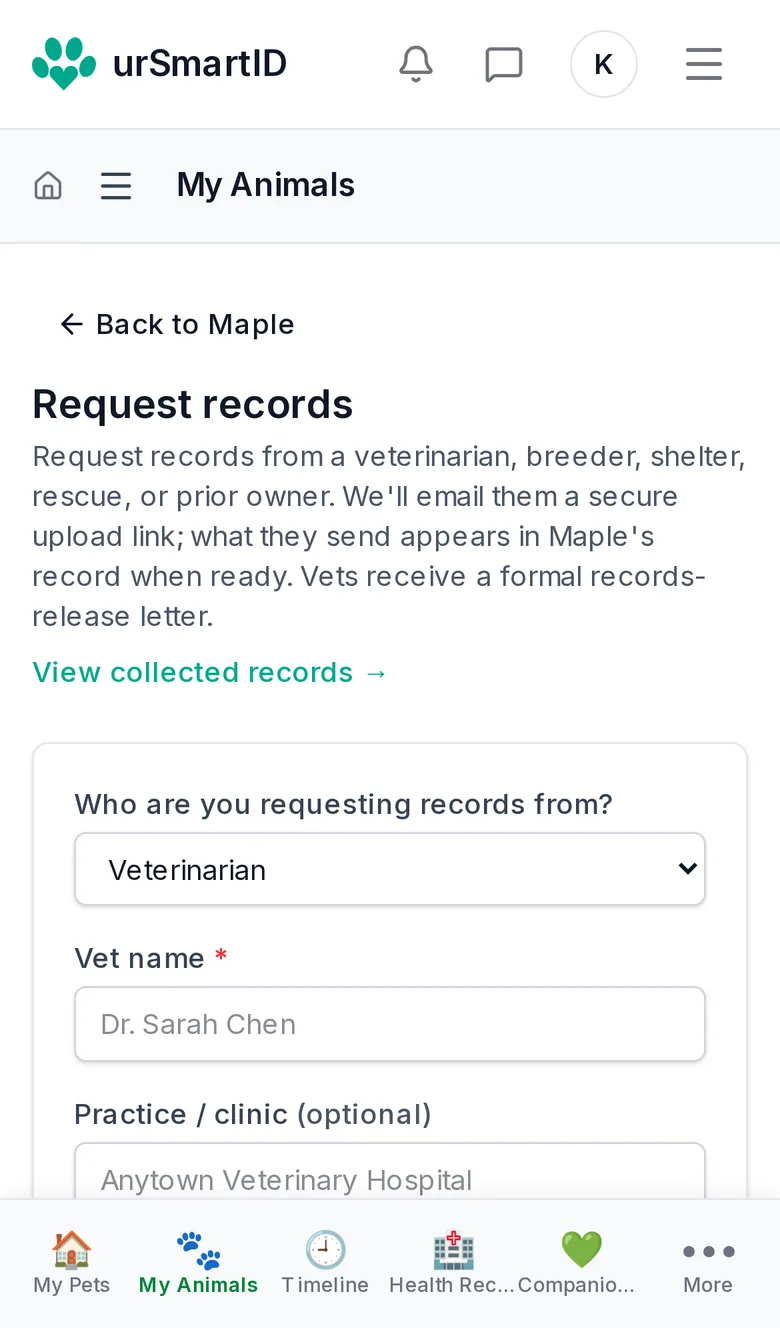
Bring in their past records
Right after activating a tag, ask their vet for past records. Breeders, shelters, rescues and previous owners can be asked from the pet’s records page.
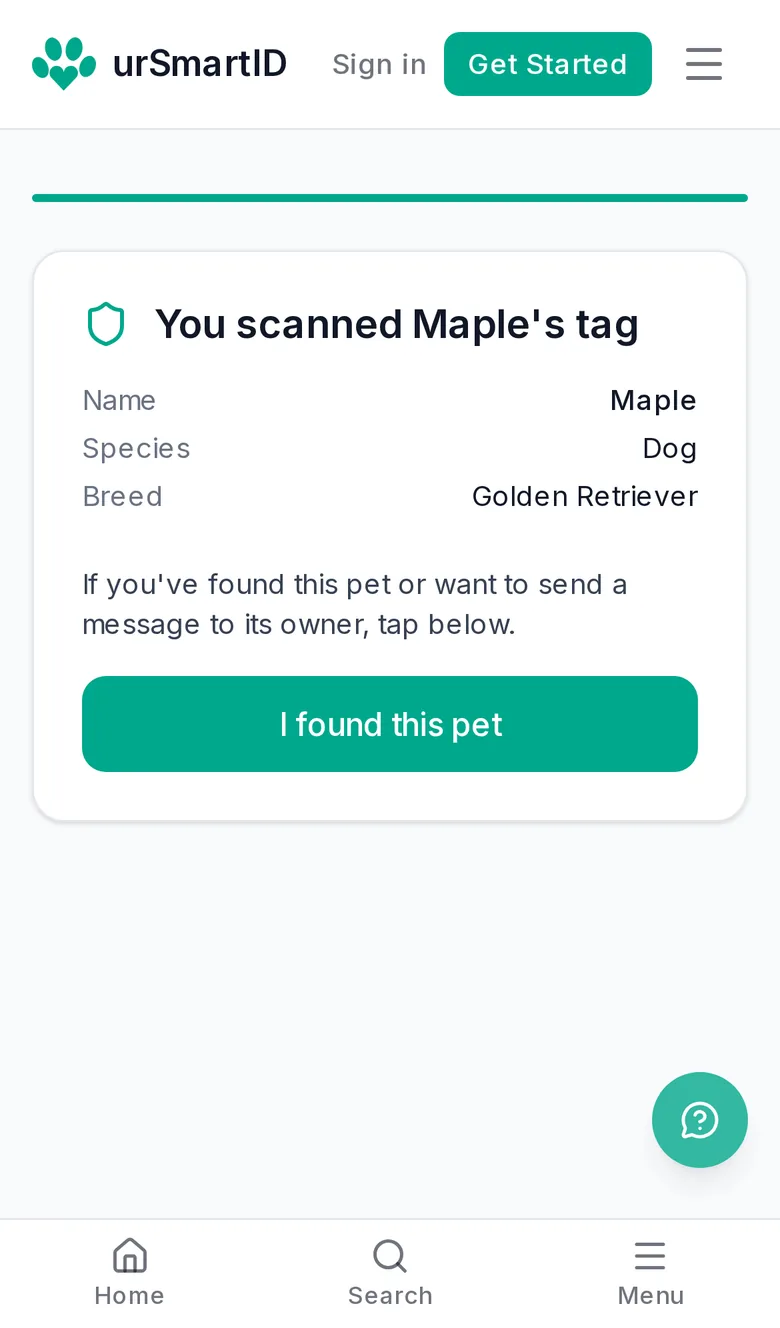
What someone sees when they scan
A finder taps or scans the tag and can tell you they have your pet, without seeing your name or number.
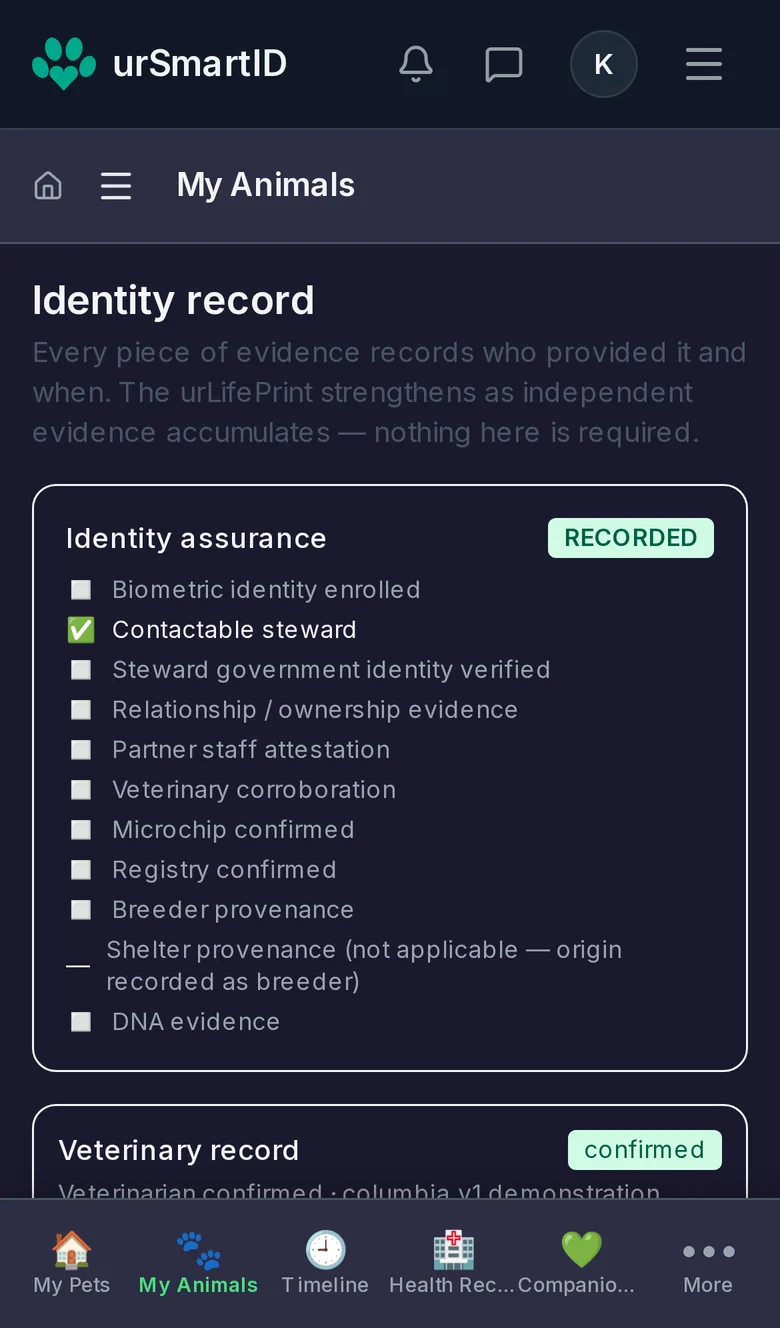
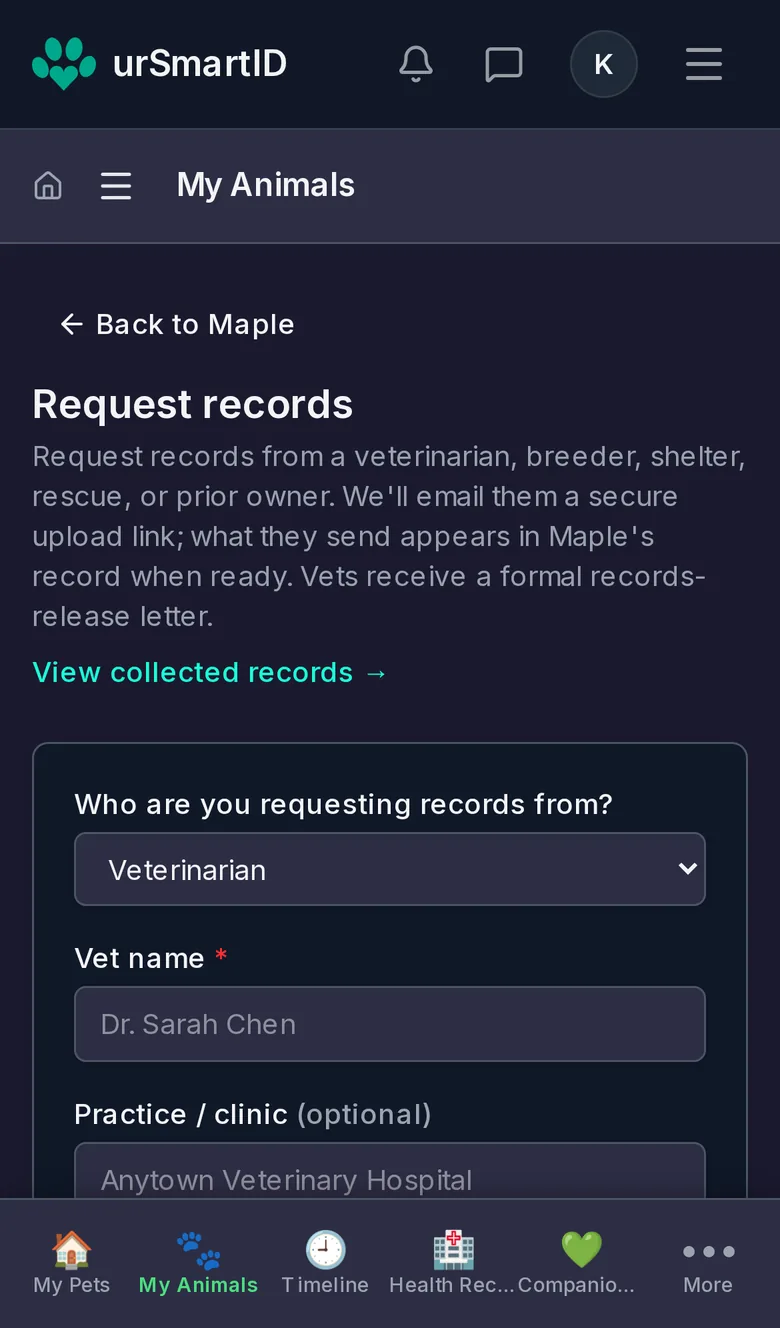
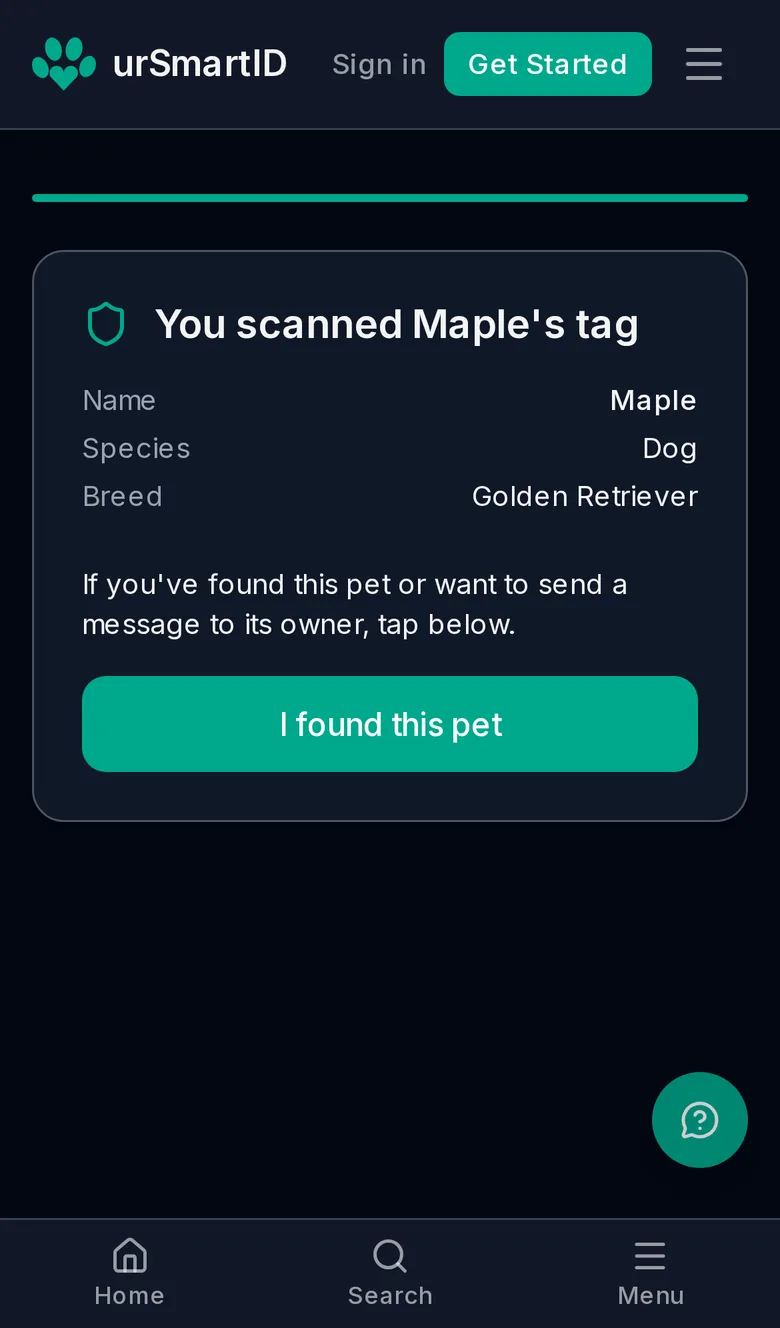
Found reports, straight to you
Anyone who scans can tell you in a few taps that they have your pet, saw them, or found only the tag. You are alerted straight away.
Private messages from finders
When your pet is marked lost, a finder can message you. You get an alert, and your reply reaches them through a private relay; neither of you sees the other’s number or email.
A Lost & Found case behind the tag
While a Lost & Found case is open, a scan of the tag alerts you (at most once an hour). With the tag in lost mode too, a finder can say "I have them" and choose to share where they are.
Mark them lost from the tag itself
Signed in, scan your own tag and mark your pet lost on the spot. Switch back to home from your Smart Tags page.
When the tag was scanned
A list of every scan of each tag: when, and whether the scanner was signed in. No location is shown.
Emergency contacts, for professionals
Choose your emergency contacts. A signed-in vet, shelter or animal-control officer who scans can call or email them with one tap; the details never appear on the page.
Badges from their vet or licensing office
Rabies vaccinated, vet verified, licensed and more: badges your pet’s own vet or licensing authority issues show on the tag page.
Orders and $10 rewards
Every tag order and its status, plus a $10 Share the Love code for each tag you buy, to pass on or use on your next one. Codes last 12 months.
For organisations, orders, and the wallet card.
Adoption hands the tag over
When a shelter completes an adoption, the pet’s tag moves to the adopter, and the handover is recorded as a permanent event. Other transfers keep the record but do not move the tag yet.
Co-branded first scan for partners
A tag issued through a participating shelter or partner can greet its new owner with that organisation’s name and logo on the first scan. We set this up with the organisation.
Issuer alerts before activation
The first time an unactivated tag issued through your organisation is scanned, your organisation’s staff get an alert, once per tag.
Wallet card emergency alerts
When someone opens the emergency code on the back of a urLifePrint wallet card, every owner on the record is told which card was opened, and when. If you have set a backup contact, they get a text too.
A $10 Share the Love code with every tag
Every tag you buy comes with a $10 code to give away or use on your next tag. One code per order; codes last 12 months.
Lost-tag replacement
Order a $5 replacement (+$4.99 shipping) from your Smart Tags page. The lost tag stops working as soon as you pay, and the pet keeps the same record.
The Hero Program
Ask an animal-welfare organisation to confirm your volunteer hours. Once they do, every 2 verified hours unlocks one $15 Hero Tag.
Planned, not available yet
We say what works today. These are on the way, and this page will say so when each one ships.
- Choosing the message and details a finder sees on your tag page
- Scan alerts whenever your pet is in lost mode, not only when a Lost & Found case is open
- Alerts for everyone on your pet’s care team, not only the owner
- At the vet and Boarding statuses that stay set
- Naming a trusted contact who can manage the tag with you
- Organisation volume pricing
- Buying a tag as a gift for someone else
Everything you know about your animal, in a form somebody else can use.
Most of what keeps an animal well lives in one person’s head. It is fine there right up until the day that person is in hospital, on a plane, evacuating, or handing over at a boarding desk — and then it is nowhere.
Not everyone who cares for your animal is you
A sitter is not a co-owner. A walker is not a vet. Each person gets the part of the record their job needs, for as long as they need it, and it closes when they are done.
- Sitter
- Feeding, routine, where things are kept, who to call.
- Dog walker
- Leash and harness notes, recall, what to avoid on the route.
- Vet of record
- Medical history, medications, allergies, prior treatment.
- Foster
- The full care picture, for as long as the placement lasts.
Who gets called, and in what order
You decide who is reached first, who is reached if they do not answer, and who after that. A plan that only works when the first person picks up is not a plan.
Continuity planning
Routine, home and environment, transport, feeding, the things that matter and the things that would never occur to you to mention. Written down once, ready for whoever needs it next.
Video, voice, documents and pictures
Some things do not survive being written down. A recording of how you call your dog, kept for whoever has to call him next. The video of how the harness actually goes on. Media attaches to the record on the private tier, and every access is audited — you can see who opened it.

“Would you ever write your name, phone number and address on a piece of paper and attach it to a telephone pole? Why would you do that with your animal?”
That is what an engraved tag is. The information is on the metal, it is on the animal, and it is readable by whoever gets there first — a good samaritan, or someone who recognises an owner who will pay anything.
urSmartID puts nothing on the tag. No name, no number, no address. The finder gets a way to reach you; they do not get you.
And it is worse when the photo goes up too — see what a lost-pet flyer actually hands over

So what does the tag carry instead?
Short opaque tokens that only resolve inside our architecture — and the identity they resolve to lives in a separate, isolated database.
Opaque tokens on the tag
The NFC chip and QR code carry short random tokens — not your name, not your pet's ID. Nobody can read a tag and 'look you up' on another service.
Junction-token isolation
Tokens resolve through a dedicated isolated database that only stores HMAC references. Even a database compromise doesn't expose owner identity without a separate junction secret.
Role-aware disclosure
A vet sees a medical summary. Animal control sees licensing. A finder sees a platform-mediated contact path. Nobody sees more than their context requires.
Your sitter can see where the food is kept without ever being able to see your door code.
Letting someone care for your animal and letting them into your home are two different decisions, and most systems collapse them into one. Here they never touch: a care grant confers no residence access at all. Getting that is a separate, deliberate act.
- A care grant is not a door keyFeeding, medication and routine carry no access to entry information. There is no setting that quietly bundles them.
- The holder must be identity-proofedResidence access is not something an anonymous account can hold, however much of the care record it can see.
- Masked, and every reveal auditedEntry credentials stay masked. Each individual reveal is recorded separately — so "who looked, and when" is a question with an answer.
We show you where each thing came from — including when the honest answer is that we don’t know.
A pet platform that always has an answer is telling you something about its confidence, not about your animal.
Expertise has more than one path
A veterinarian, a forty-year breeder and a species keeper know different true things. We record which kind of knowledge you are looking at instead of flattening all three into one voice.
Welfare before marketing
Where what sells and what is good for the animal disagree, we say what is good for the animal — including when that costs us the sale.
Knowledge has a date on it
Guidance changes. What was right for a puppy is wrong for the same dog at ten. We keep the date and the life stage attached, so old advice cannot quietly pass as current.
Pets, livestock, shelter animals, licensed animals.


Pet owners
A collar tag that lets a finder tell you they have your pet without seeing your number, and shows a medical summary to the vets, shelters and animal-control officers who scan it.
Breeders
Early-life records attributed to you, on a record that stays with the animal after it goes home.
Shelters & rescues
Intake-to-adoption tracking. The tag travels with the animal to its new home without re-provisioning.
Municipalities
When animal control scans a tag, the officer sees current license status, number and expiry, and can reach the pet's emergency contacts with one tap.
Four different things people call a pet ID.
They solve different problems, and the honest answer is that most animals should have more than one of them.
| Engraved tag | Microchip | GPS tracker | urSmartID | |
|---|---|---|---|---|
| Readable with no app | Yes | No — needs a scanner | No — needs the maker’s app | Yes |
| Personal details on the tag | Yes — name and number, in metal | No | No | No |
| Works with a dead battery | Yes | Yes | No | Yes — no battery at all |
| Finder can reach you without your number | No | Via the registry, if current | Varies | Yes — a found report; private messages once marked lost |
| Medical information for a vet | No | No | No | Yes |
| Ongoing cost | None | Registry fees vary | Subscription | None |
Every column above, ours included, was checked on . Competitor categories vary by product and by registry; where a row says “varies”, that is the finding, not a hedge.
Designed for everyday wear.
Rugged and water-resistant
Stainless steel sealed in epoxy. No battery, no electronics, nothing to charge or replace — built for daily wear.
Nothing to charge, nothing to fail
Passive NFC plus a printed QR. No battery means no dead tag on the day it matters, and no replacement cycle.
NFC NTAG213 + unique short code
Industry-standard chip, plus a human-readable backup code printed on the enamel back beside the QR.
UV-protective finish
Designed for everyday wear — scratch-resistant and sun-stable so it stays legible.
One price. Everything your pet needs.
No tiers, no upsells, no monthly fees. The $39.99 launch price covers the tag and platform access for as long as urSmartID is in service — no renewal, no tier, nothing further to pay.
- Premium stainless steel NFC smart tag
- Secure QR code backup
- Registration with nothing to renew
- No subscription fees
- No monthly charges
- Your phone number and address are never on the tag
- Lost pet recovery tools
- Medical records and emergency contacts, shown to vets, shelters and animal control who scan (not to the public)
- You choose your emergency contacts and switch lost mode on or off
- Platform access for as long as urSmartID is in service
- Lost-tag replacement for $5 (+$4.99 shipping), ordered from your dashboard
A $10 Share the Love Reward, on us.
Every tag comes with a $10 reward to pass along. Give it to a friend, a family member, or a fellow pet lover — or use it yourself toward an additional urSmartID tag. Because every pet deserves to be found.
No problem.
Order a replacement from your dashboard for $5 + $4.99 shipping. The lost tag stops working as soon as you pay. Activate the new tag to the same pet and keep going — nothing about your pet's record changes.
- The same profile
- The same records
- The same permissions
- The same history
The old tag is deactivated when your payment goes through. Your pet's profile, records, and history carry straight over to the new tag.
Volunteer. Help animals. Become a Hero.
Every 2 verified volunteer hours with a participating animal-welfare organization makes you eligible for a $15 Hero Tag — the same premium urSmartID tag. Not a coupon. A thank-you.
Good to know.
How much does it cost?
The regular retail price is $49.99. During our introductory launch it’s $39.99, and every tag includes a free $10 Share the Love Reward to gift or use toward another tag. No subscription and no monthly fees — ever.
Does it replace a microchip?
No — it complements one. A microchip needs a vet or shelter with a scanner. urSmartID works with any phone the moment your pet is found, so an everyday good samaritan can reach you in seconds.
Do I need an app?
No. NFC tap and QR scan both open a web page in the phone’s browser. Nothing to install for you or for whoever finds your pet.
What if I lose the tag?
Order a replacement from your Smart Tags dashboard for $5 + $4.99 shipping. The lost tag stops working as soon as you pay. Your pet keeps the same profile, records, permissions, and history — activate the new tag to the same pet and continue.
What does someone see when they scan it?
What their role needs. Anyone who scans can tell you, in a few taps, that they have your pet, saw them, or found just the tag. When your pet is marked lost, strangers see a lost alert and can message you privately, without your name or number. A signed-in vet, shelter or animal-control account also sees the medical summary and emergency contacts; animal control sees licensing. The tag never reveals your pet’s identity directly.
Will it survive water and rough play?
Rugged and water-resistant. Stainless steel sealed in epoxy. No battery, no electronics, nothing to charge or replace — built for daily wear. The durability claim we will stand behind is the one about electronics: there is nothing inside to fail, get wet, or run flat.
What is the Hero Program?
A recognition program: every 2 verified volunteer hours with a participating animal-welfare organization makes you eligible to purchase a $15 Hero Tag. Hero Tags are for animals in your own household and are not for resale.